


What KYC is, and why every big exchange asks
KYC stands for know your customer.
It's the reason an exchange wants your passport, a selfie and a utility bill before you can buy a single coin.
And here's the part most guides skip: it's not the exchange's idea. It's the law the exchange has to follow.
Where it comes fromOne standard, copied into national law
The rulebook starts at the FATF, the global body that sets anti-money-laundering standards. It says crypto businesses must apply the same preventive measures as other financial institutions: check customers, keep records, report suspicious activity, and send the sender's and receiver's details along with every transfer. That last part is called the travel rule.
The FATF also draws a line you'll see everywhere. For one-off transactions, it sets the point where checks become mandatory at USD/EUR 1,000.
Countries then write that into their own law:
- United States: an exchange is a money transmitter under the Bank Secrecy Act, supervised by FinCEN.
- European Union: the travel rule for crypto has applied since 30 December 2024, for transfers of any size. And from 10 July 2027, crypto firms are banned from keeping anonymous accounts, or accounts for coins built for anonymity.
In practiceWhat a typical exchange asks for
Most exchanges ask in tiers. The more you want to do, the more they want:
- An email and a password. Enough to look around.
- A phone number. Now the account is tied to your SIM card.
- A photo of your ID. Passport, driver's license or national ID card.
- A selfie or a video. To match your face to the photo.
- Proof of address. A bank statement or a utility bill.
Five steps, and a company you've never met now holds a full copy of who you are and where you sleep. For the rules behind each step, and how long that copy is kept, read what KYC in crypto really means.
- KYC means know your customer: the identity checks anti-money-laundering law puts on financial businesses.
- The global standard comes from the FATF; the US, the EU and others write it into their own law.
- In the EU, crypto firms can't keep anonymous accounts at all from 10 July 2027.
Why people skip KYC: the ID pile leaks
Ask people why they avoid KYC and you'll hear one word: leaks.
Not because they have something to hide. Because a list of people who own crypto, with their home addresses, is exactly what a criminal wants.
Case studyThe 2025 Coinbase incident, step by step
Here's what Coinbase, one of the largest US exchanges, told the SEC in May 2025.
Step 1: insiders were paid. According to the filing, the attacker got the data "by paying multiple contractors or employees" working in support roles outside the United States.
Step 2: records were copied from the internal systems those support staff could reach.
Step 3: the demand. On 11 May 2025 the company received an email that demanded money in exchange for not publishing the information.
Step 4: the damage. Here is what the filing lists as taken:
- Name, address, phone and email.
- The last four digits of Social Security numbers.
- Masked bank account numbers.
- Government ID images, like driver's licenses and passports.
- Balance snapshots and transaction history.
Step 5: the bill. Coinbase estimated the cost at about $180 million to $400 million.
"Government-ID images (e.g., driver's license, passport)"Coinbase Global, Form 8-K, May 2025
Notice what wasn't needed: no wallet was cracked, no blockchain was broken. The weak point was the pile of IDs.
Put balances next to home addresses and you've built a list of who to phone, pretending to be support. Or who to visit.
Every company you hand ID to becomes one more copy of it. You can't control how well each one guards it. You can control how many copies exist.
- The real risk isn't the blockchain. It's a database that ties your name and home address to the fact that you own crypto.
- In 2025, Coinbase reported names, addresses and government ID images copied by paid insiders.
- Every exchange you give ID to is one more place that can leak it.
Is buying crypto without KYC legal?
In many places, yes. Here's why, in the regulators' own words. (This is information, not legal advice. Rules differ by country.) For the US, EU and UK rules side by side and the cases behind them, see is buying crypto without KYC legal?
The businessThe duty to check sits on the seller
KYC laws are written for financial businesses: exchanges, brokers, kiosk operators. Look at the US rulebook. FinCEN's 2019 guidance says a person who obtains crypto to buy goods or services on their own behalf is a user, not a money transmitter. The same goes for people using their own wallets on their own behalf.
The lineWhen a P2P seller becomes a business
The same guidance says someone who sells crypto to strangers as a business is a money transmitter and must register and follow the rules. A person who does it infrequently and not for profit is exempt.
So the one-off seller is fine. The person running a side business of daily trades is not, and that matters to you as a buyer: the more professional the seller, the more likely they'll ask for ID.
YouWhat still applies to you
- Tax. The IRS says income from digital assets is taxable, and every Form 1040 asks whether you received or disposed of any. No KYC doesn't mean no tax.
- Reporting lines. Splitting payments to stay just under a reporting threshold is something FinCEN tells businesses to flag. Don't do it.
- Sanctions and crime. Obviously, none of this covers dealing with sanctioned people or paying for crime.
- The KYC duty sits on businesses, not on the person buying.
- FinCEN says people using crypto on their own behalf are not money transmitters; someone selling crypto as a business is.
- Tax applies whichever route you use.
The two doors: your first coin vs changing coins
Here's the idea that makes this whole topic simple. Every other guide misses it.
There are two doors, and they're completely different.
Door one: money in, first coin out. You have cash or money in a bank, and you want crypto. Someone has to accept your money: a person, a machine, an exchange. That someone is who might ask for ID. And if you pay by bank or card, your bank already knows it was you.
Door two: coin in, another coin out. You already hold some crypto, from a friend, from work, from an old account. Now you want a different coin. Nobody needs your money; they need your coin and an address to send the new one to. A swap with no accounts asks for exactly that, and nothing else.
Why does this matter? Because the hard part happens once. Get through door one with any coin, by any route, and every move after that can go through door two. That's exactly what our swap with no ID does, and you can see the whole trip in how a swap works.
- Getting your first coin needs someone who accepts your money: that's where ID gets asked.
- Changing a coin you hold into another needs only a wallet address.
- Once you're through door one once, every later move can go through door two.
Every route to crypto without ID, side by side
There are five routes that work. Four go through door one. One goes through door two.
| Route | You hand over | Cost | Main risk | What still leaks |
|---|---|---|---|---|
| P2P trade, cash | Nothing on paper | The seller's premium | Fake sellers, meeting safety | Your face, to the seller |
| P2P trade, bank | Your bank name | The seller's premium | Payment tricks | Your bank record |
| Crypto kiosk | A phone number, sometimes ID | 7% to 20% (FinCEN) | Scams that send you there | Your face on camera |
| Earn it | Your work | Your time | Clients who don't pay | The client knows you |
| Mine it | Hardware and power | Varies a lot | It costs more than it earns | Your power bill |
| Swap a coin you hold | A receiving address | Shown before you send | Sites that ask for ID halfway | Only the public chain |
Route 1A P2P trade
You buy straight from another person, in person for cash or online with a bank or app payment. The best versions use escrow: the seller's coins are locked until your payment lands. Chapter 7 covers how to do it safely, and our P2P guide goes deeper.
you meet a seller in a coffee shop, pay cash, and watch the coins arrive in your wallet before you leave.
Route 2A crypto kiosk
A machine that takes cash and sends coins to your address. Fast, and the most expensive route on this list. Chapter 6 has the numbers.
Route 3Earn it
Get paid in crypto for work or for something you sell. Your client knows you, but no exchange stands in between.
a freelance designer asks one client to pay an invoice in Bitcoin to a fresh address.
Route 4Mine it
Run hardware that helps secure a network and earns new coins. Honest note: for most people at home, the power bill makes this more of a hobby than a way to buy crypto.
Route 5Swap a coin you already hold
Door two. If you have any crypto, even a small amount of a coin you don't want, a swap with no account turns it into the coin you do want. No ID at any size it supports.
Your turnFind the route that fits you
Which route fits you?
Three taps. Nothing you pick leaves this page.
What do you have now?
Roughly how much?
What matters most?
0 of 3 answered.
- Door one has four routes: P2P trades, crypto kiosks, earning crypto and mining.
- Every route leaks something. Pick the leak you can live with.
- If you hold any coin already, door two beats all of them.
Bitcoin ATMs: what they ask, what they cost, and who uses them against you
Crypto kiosks look like the easy answer. Walk up, feed in cash, get Bitcoin.
Here's what the US Treasury's FinCEN actually found when it looked at them.
What they askID: it depends on the machine
FinCEN says kiosk identification "can range from a phone number to a scan of a government-issued ID". Kiosk operators are money transmitters, so the same rules apply to them as to exchanges.
What they cost7% to 20%
Same notice: kiosk fees range from 7% to 20%. On $500, that's $35 to $100 gone before the coins arrive.
Who uses them against youThe kiosk scam
This is the dark side, and it's big:
- The FBI received 13,460 complaints involving crypto kiosks in 2025, with $389 million lost. People 60 and over lost $257 million of it.
- The FTC found kiosk scam losses rose nearly tenfold to over $110 million in 2023.
The script is almost always the same. Someone calls pretending to be your bank, the government or tech support. They say your money is in danger. Then they send you to a kiosk to "protect" it, with their QR code.
No real bank, government agency or support desk will ever tell you to pay at a crypto kiosk. If anyone does, hang up.
Thinking of using one anyway? Our guide to Bitcoin ATMs without ID covers the state limits, the fees in dollars and a checklist for before you start.
- Kiosks ask for anything from a phone number to an ID scan, and charge 7% to 20%.
- Kiosk scams cost Americans $389 million in 2025, according to the FBI.
- No real bank, government agency or support desk will ever tell you to pay at a crypto kiosk.
P2P trades without getting robbed
P2P is the most private way to get a first coin. It's also where fake sellers wait.
The FBI's 2025 report puts crypto-related losses at $11.366 billion, most of it from investment fraud. A stranger offering a great rate is how many of those stories start.
How escrow worksA glass box between you
The seller locks the coins first. You pay. The seller confirms, and the coins are released to your wallet. If either side cheats, the coins stay locked while it's sorted out.
The safety rulesFive habits that prevent most losses
- Use escrow, always. Never send money to someone whose coins aren't locked first.
- Start with a small first trade. A seller who's honest with $50 is more likely to be honest with $500.
- Meet in public, in daylight. A busy café beats a parking lot.
- Pay in a way you understand. Cash in person is final. Some app payments can be pulled back by the sender, which is exactly what scammers exploit when they're the ones paying.
- Distrust a rate that's too good. Sellers charge a premium for privacy. One who doesn't usually wants something else.
Want the depth? P2P crypto without KYC compares every escrow design and shows which payments can be pulled back on you.
- Escrow locks the seller's coins until your payment lands, which protects both sides.
- Cash in person is the most private; bank and app payments leave a record.
- Start small, and treat a rate that's too good as a warning.
The playbook: how to buy crypto without KYC, step by step
Here's the whole thing in order. Follow it and the coin you end up with has no ID behind it.
Step #1Set up a fresh wallet first
A wallet you control, on your phone or computer, that has never touched an exchange account. Everything else lands here.
Step #2Pick your door
Hold any crypto at all? Skip to step 6. If not, you need door one.
Step #3Pick a route that fits your amount
Use the table in chapter 5, or the route finder. Small cash amount and no time? A kiosk, if you can stomach the fee. Privacy first? A P2P trade in person.
Step #4Start with a small test
Whatever the route, do a small first round. You learn the steps when a mistake is cheap.
Step #5Receive to a fresh address
Never an address you've used with an ID-checked account. Our privacy guide explains how one shared address links two wallets for good.
Step #6Swap into the coin you actually want
Got Bitcoin but want Monero? Got USDT and want Bitcoin? Swap it with no account, paid straight to your wallet. For example: USDT on Tron to Bitcoin or Bitcoin to Monero. For the private-payment routine, read how to send crypto anonymously.
Here's exactly what that looks like on our desk, screen by screen.
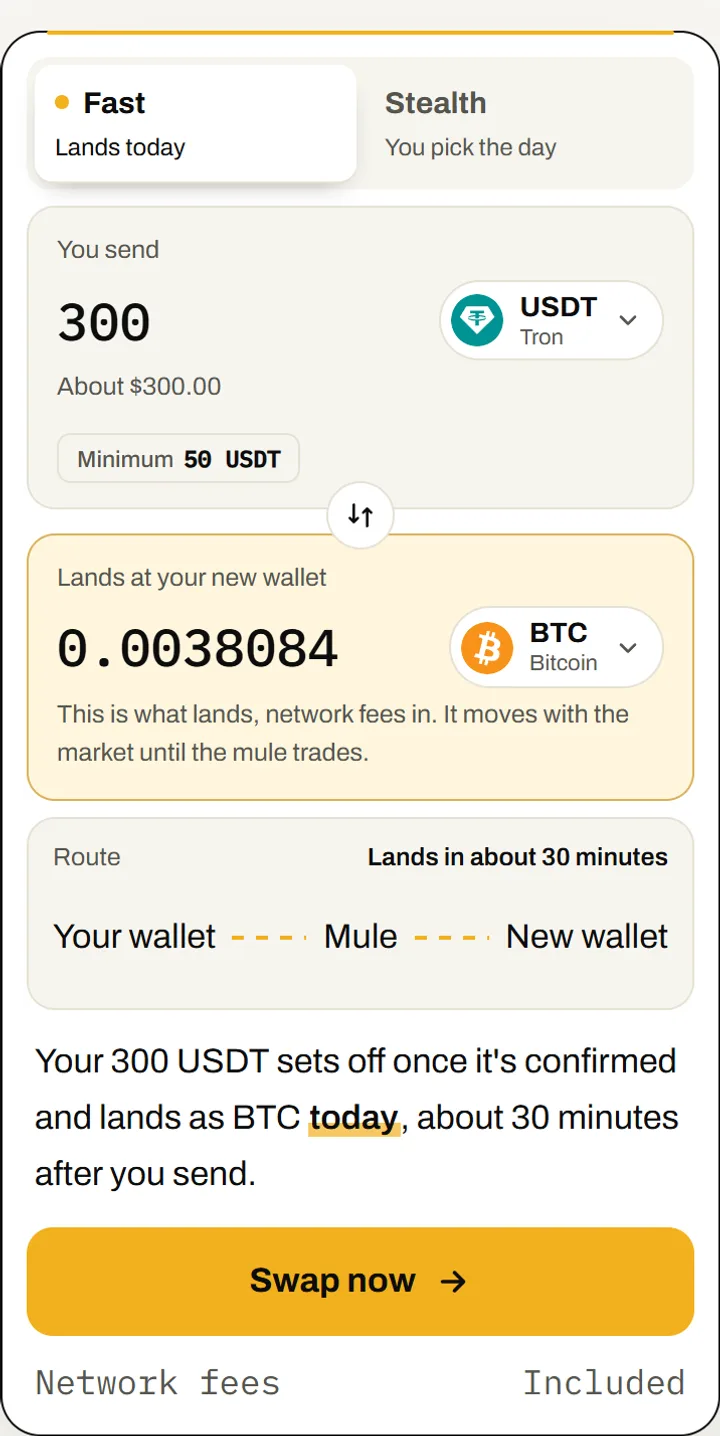 Screen 1Pick your coins
- What lands at your wallet, network fees already out. You see it before you send.
- When it lands. No form to fill in first.
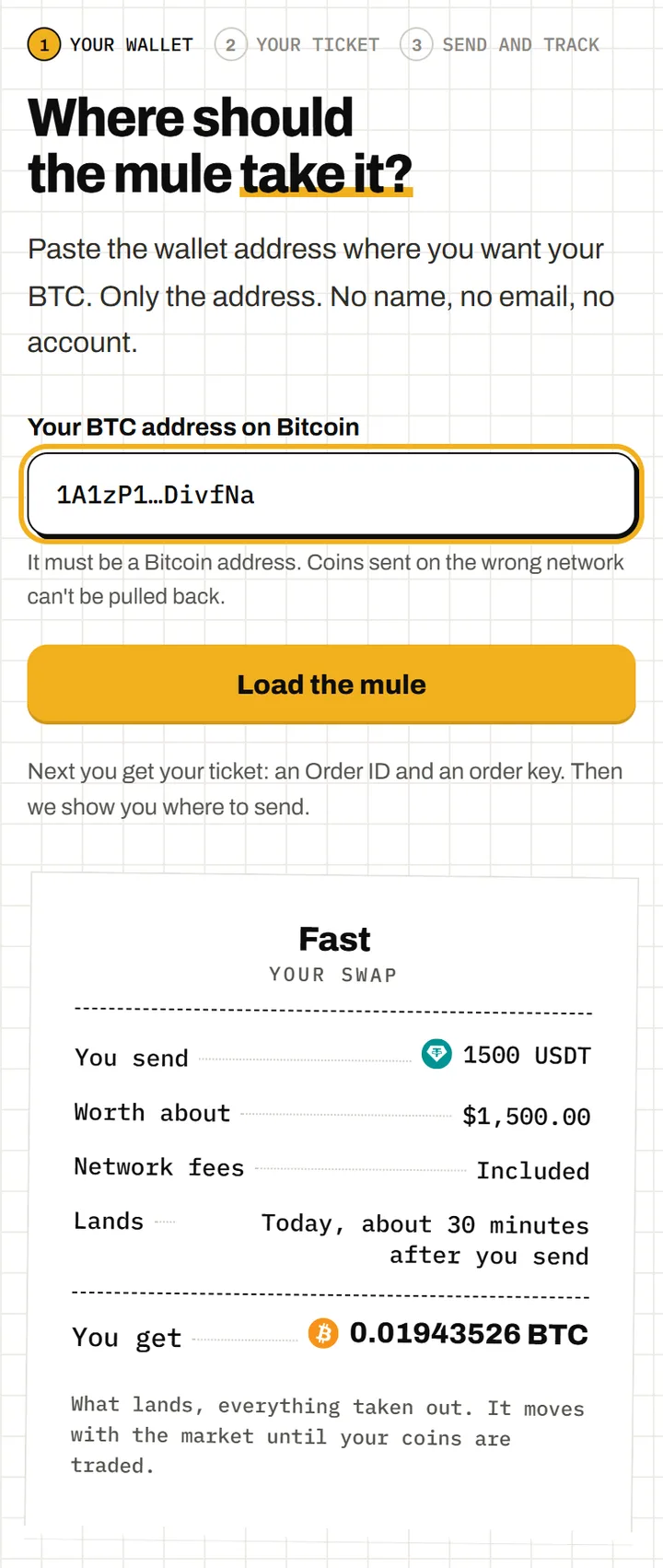 Screen 2Paste your address
- The only thing we ask for: where to send your new coins. No name, no email.
- The receipt: what you send, what it's worth, and what you get.
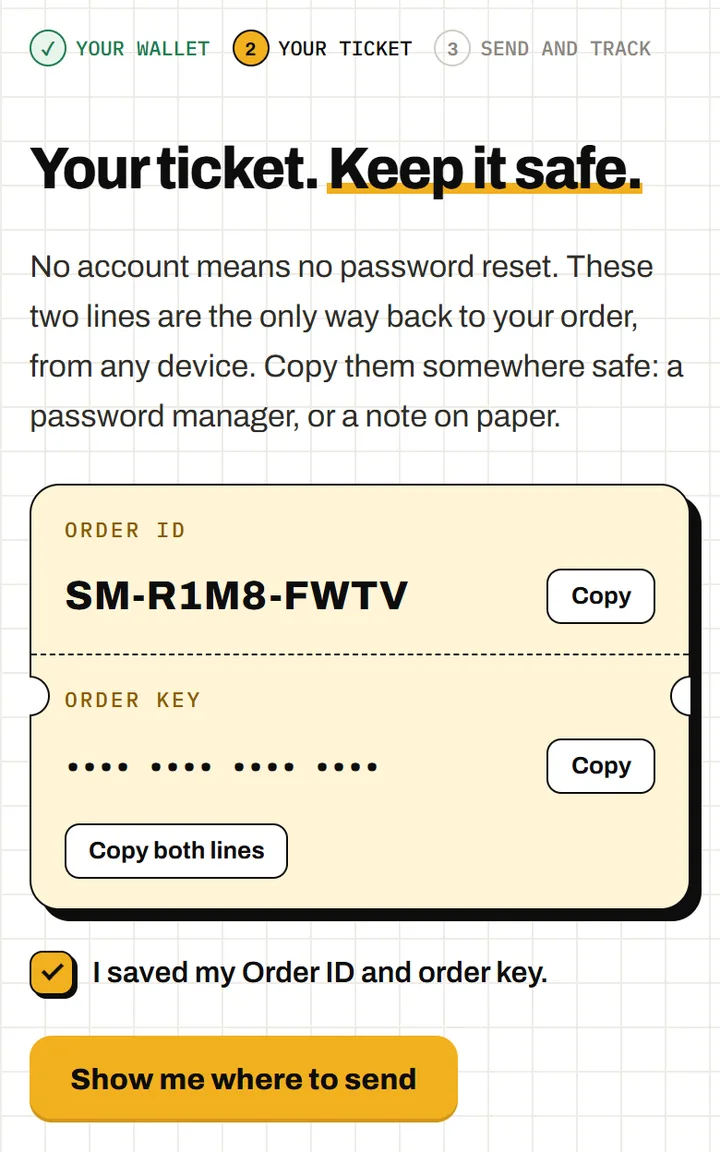 Screen 3Save your ticket
- An Order ID and an order key replace the account. Keep both.
- Tick it, and the desk shows you where to send.
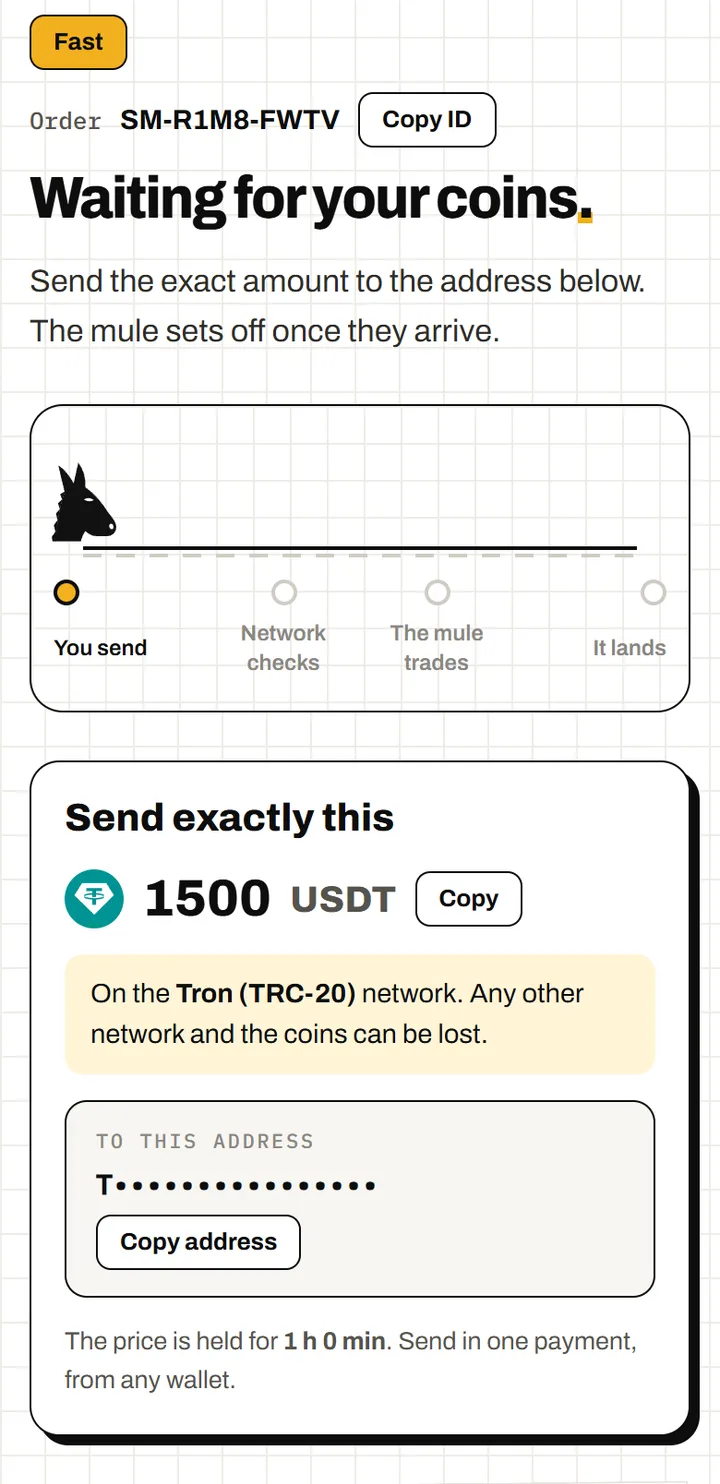 Screen 4Send, then watch the trip
- Every stop of the trip, live. Close the page and come back with your ticket.
- Send exactly this, on this network. One payment, from any wallet.
Step #7Keep a note for tax
Date, amount, what you paid. No KYC doesn't mean no tax, and a simple note now saves a headache later.
- Set up the wallet first, and never receive to an exchange account.
- If you already hold any coin, use door two.
- Test small, receive to a fresh address, and keep a note for tax.
Mistakes that undo it all
Getting a coin without ID is half the job. Keeping your name off it is the other half.
- Sending no-ID coins to an exchange account
The exchange now has a deposit from that wallet next to your name. The wallet's whole history is yours.
- Mixing ID and no-ID coins in one wallet
Spend them together once and the chain treats them as one owner. Keep two separate wallets.
- Reusing an address
Everyone who paid that address can see everyone else who did.
- Believing "no KYC with a card"
A card payment is always tied to your bank. The seller may not ask, but the record exists.
- Paying a P2P seller with a reversible payment
Or accepting one when you're the seller. Payment tricks cause more losses than anything on the chain. Check which payments can be pulled back.
- Following anyone who sends you to a kiosk
That's the scam script, every time.
- Splitting payments to stay under limits
FinCEN tells businesses to flag exactly that. It draws attention instead of avoiding it.
- Sending the whole amount on a first trade
Test small. Always.
- Forgetting the tax note
The tax rules don't care how you got the coin.
Now it's your turn. If you already hold a coin, door two is right below: pick what you have, pick what you want, paste a fresh address.
- One deposit from a no-ID wallet into an account with your name links the two for good.
- A card or bank payment always carries your name.
- Splitting payments to dodge reporting is a red flag, not a strategy.
Keep reading
- Is buying crypto without KYC legal?Who the law binds, where a buyer becomes a business, and who has been charged.
- What is KYC in crypto?What exchanges must ask, and how long they keep your ID after you leave.
- Bitcoin ATM without IDWhat kiosks ask, the limits and fees in dollars, and the scam the FBI warns about.
- How to swap cryptoDoor two in full: networks, fees and memos, once you hold a coin.
How we checked this
Written by the team that runs the SilentMule swap desk. Every rule is quoted from the law or the regulator that wrote it, every figure from the government report or company filing that states it, linked where it appears. Nothing here is legal advice, and rules differ by country. Last checked . Spotted something wrong? Tell us and we fix it.
Sources
- FATF: virtual assets
- FATF: Interpretive Note to Recommendation 15
- FinCEN guidance FIN-2019-G001, 9 May 2019
- FinCEN notice FIN-2025-NTC1 on crypto kiosks, 4 August 2025
- EU Transfer of Funds Regulation (EU) 2023/1113
- EU Anti-Money Laundering Regulation (EU) 2024/1624
- Coinbase Global, Form 8-K filed with the SEC, May 2025
- FTC, 3 September 2024: bitcoin ATM scam losses
- FBI Internet Crime Complaint Center, 2025 annual report
- IRS: digital assets