


What a crypto swap is (and what it isn't)
A swap is simple: one coin in, another coin out, at a price you see first.
But "swap" gets mixed up with three other things. Let's pull them apart:
- Swap vs trade. A swap is one quoted exchange. Trading means placing orders on an exchange's order book, where you set the price and wait for a match.
- Swap vs send. A send moves the same coin to someone else. A swap changes the coin.
- Swap vs bridge. A bridge moves the same asset to another chain. A swap changes the asset.
Where swaps happenFour places, four ways of holding your coins
- An exchange account. You deposit, swap inside the account, withdraw. The exchange holds your coins the whole time they sit there.
- A DEX (decentralised exchange). A smart contract swaps two tokens on one chain in a single transaction.
- An instant swap service. You send one coin; it sends another, often on a different chain. It holds your coins between your deposit and your payout. That's what our desk is.
- A bridge. Moves the same asset to another chain. More on bridges in chapter 9.
ETH to USDC on Ethereum: one chain, so a DEX can do it. BTC to ETH: two chains with no shared ledger, so someone has to hold one side while the other is sent. That's the job of a swap service.
In the US, the IRS says exchanging one virtual currency for another means you "will recognize a capital gain or loss". Rules differ by country. Don't have any crypto yet? Start with how to get your first coin without ID.
- A swap turns one coin into another at a quoted price, with no cash in between.
- Swaps happen in four places, and each one holds your coins differently in the middle.
- In the US, swapping one coin for another is a taxable event.
The network is part of the coin
This is the single most important idea in this guide. Most lost swaps start right here.
A coin's ticker doesn't tell you where it lives.
Take USDT. Tether lists it on 13 live networks: Ethereum, Tron, Solana, TON, Avalanche and more, each with its own contract. It has also stopped issuing on five older ones.
Tether says the tokens should be treated as equal in value. But on the chains themselves, they're separate balances on separate ledgers. A Tron wallet can't see a deposit made on Ethereum. There's no road between them.
What the labels meanERC-20, TRC-20 and the rest
ERC-20 is Ethereum's token standard, a shared set of functions every token uses, proposed in November 2015. TRC-20 is Tron's version, which Tron's docs call fully compatible with ERC-20 at the interface level. Same design. Different ledger. Our TRC-20 vs ERC-20 guide compares the two with real fees.
That's why our desk asks for the coin and the network, every time. Here's what it looks like:
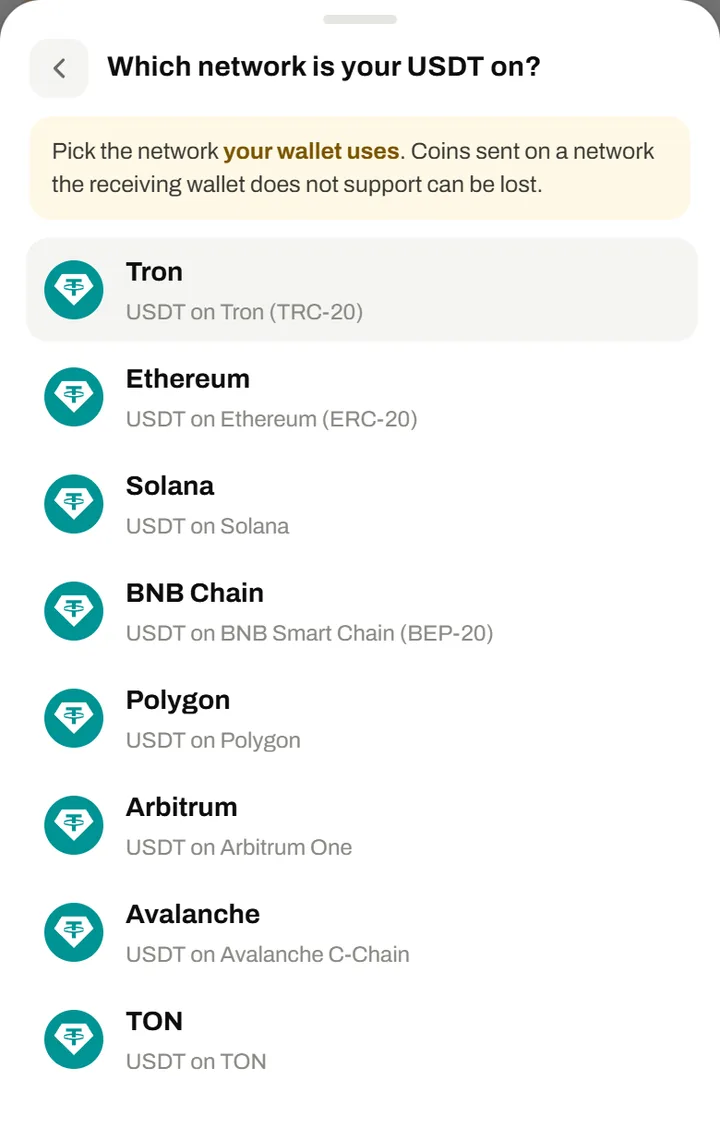 Screen 1Which network is your USDT on?
- The warning comes first: pick the network your wallet uses.
- One coin, eight roads. Each line is a separate token on a separate chain.
Every coin and network we carry is on our coins page, and the USDT page lines the networks up side by side.
- One ticker can live on many networks: Tether lists USDT on 13.
- The tokens are equal in value but separate on-chain: each network keeps its own balance.
- Always pick the network your receiving wallet uses, not just the coin.
Read the address before you paste it
An address isn't random. Its first few characters tell you a lot.
- Bitcoin addresses start with 1, 3 or bc1. The newest kind, bc1, isn't case-sensitive.
- Ethereum addresses are 42 characters starting with 0x.
- Tron addresses are 34 characters starting with T.
Here's the trap. A 0x address has the same shape on every Ethereum-style chain: Ethereum, BNB Chain, Polygon, Arbitrum and more. Paste it, and nothing about the address itself says which chain you meant.
Checksums help with typos: the Bitcoin Wiki puts the chance of a mistyped address still passing at about 1 in 4.29 billion. But no checksum knows which network you picked, or that malware swapped the address in your clipboard.
Try itCheck an address against a network
Will this swap land?
Pick the network you're receiving on. Paste the address if you like. Nothing you type leaves this page.
Receiving network
- Address shape
- Starts like
T.... Paste one to check it. - Memo or tag
- Not used on this network.
- Fees here
- Paid in TRX (or Energy from staked TRX). To move a token on Tron later, the wallet needs a little of it.
- The first characters tell you the network family: bc1, 1 or 3 for Bitcoin, T for Tron, 0x for Ethereum-style chains.
- A 0x address is valid on many chains at once, so the network you pick decides where coins go.
- Checksums catch typos, not the wrong network or a swapped address.
Every fee in a swap, line by line
"Low fees" means nothing until you know which fees. Every swap has up to four:
- The fee to send. You pay the sending network to move your coin.
- The swap's price. The spread or service fee of whoever does the swap.
- Price movement. The market can move between the quote and the trade (chapter 5, and in full in crypto slippage).
- The fee to deliver. The receiving network charges to send you the new coin.
How chains chargeGas, bytes and Energy
Ethereum charges for computation. The fee is gas used times (base fee plus priority fee), the base fee is burned, and a plain ETH transfer uses 21,000 gas.
at a combined 2 gwei per unit (1 gwei is a billionth of an ETH), a plain transfer costs 21,000 × 2 = 42,000 gwei, or 0.000042 ETH. A token transfer uses more gas than that.
Bitcoin charges for space, not money. Fees are based on the size of the transaction in bytes, so sending 0.001 BTC and 10 BTC from one coin can cost the same.
Tron uses two resources. Bandwidth covers size, and each activated account gets 600 free Bandwidth a day. Energy covers smart contract work, which every USDT transfer needs, and has no free quota. Without enough of either, TRX is burned to pay. On 3 November 2026 that made a Tron USDT transfer cost about a hundred times an Ethereum one for a wallet with no Energy: the receipts are in TRC-20 vs ERC-20.
- A swap has up to four costs: the fee to send, the swap's price, price movement, and the fee to deliver.
- Ethereum charges for gas used, Bitcoin for transaction size, Tron for Energy and Bandwidth.
- The only number that matters is what lands. A good quote shows it with everything out.
Slippage, price impact, and fixed vs floating rates
The price you see isn't always the price you get. Here's why, and what to do about it.
On a DEXPrice impact and slippage
A DEX prices a swap from a pool of two tokens. The bigger your trade compared with the pool, the further it moves the price: price impact. The formula and a calculator are in our guide to crypto slippage.
Slippage tolerance is your limit. ethereum.org puts it simply: at 1% slippage, the minimum you receive is the expected amount minus 1%. Set it too high and you invite trouble: traders who are "sandwiched" by bots face increased slippage and worse execution.
On a swap serviceFixed vs floating
Services that swap across chains quote in one of two ways:
- Fixed: the amount you'll receive is locked when you order, and the service takes on the price risk until your coins arrive.
- Floating: the amount is set when your coins arrive, at the market price then.
- On a DEX, bigger trades in smaller pools move the price more: that's price impact.
- Slippage tolerance is the worst price you'll accept.
- A fixed quote locks the amount; a floating one is set when your coins arrive.
Memos, tags and comments: the second address
Some coins need a second piece of information next to the address. Skip it when it's needed, and your coins can end up in limbo. Every coin's rule, and what to do if you forgot one, is in our guide to crypto memos and destination tags.
Why does it exist? Exchanges often use one shared address for many customers. The XRP Ledger docs explain that tags tell the exchange which customer to credit, because giving every customer their own funded address would be costly. A receiver can even set the ledger to reject payments without a tag.
- XRP: a destination tag, a number.
- Stellar: a memo.
- TON: a comment. TON's docs warn that deposits without the right identifier "may be lost".
you withdraw XRP from a wallet to an exchange and leave the tag empty. The coins reach the exchange's address, but nothing says they're yours.
Here's how our desk handles it when you're receiving XRP:
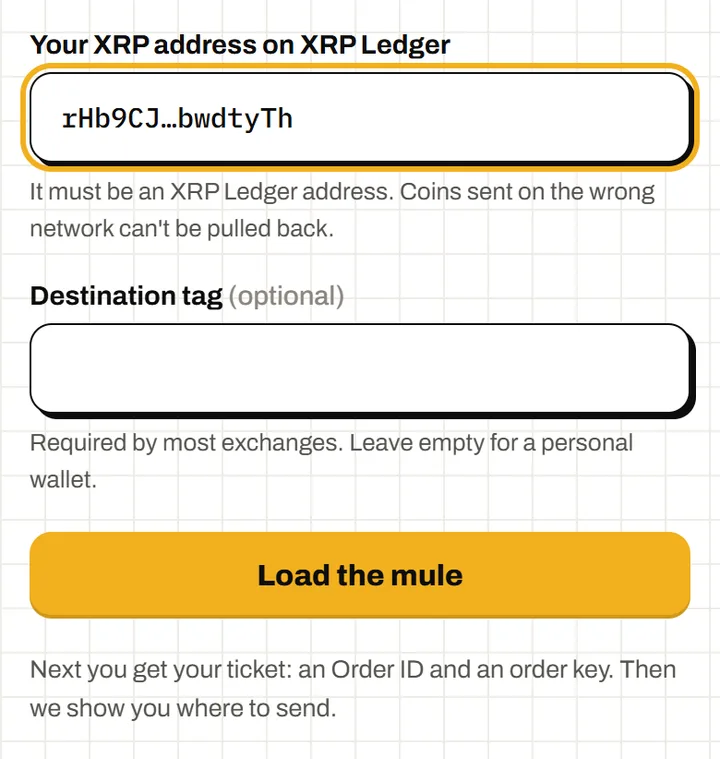 Screen 1Receiving XRP
- Your XRP address. The hint names the network, so a wrong one is caught here.
- The tag field: fill it for an exchange, leave it empty for your own wallet.
Sent without a memo already? Our help page covers what can and can't be fixed.
- Some exchanges use one shared address for many customers; the memo says whose deposit it is.
- XRP uses destination tags, Stellar memos, TON comments.
- To your own wallet, leave it empty. To an exchange, never skip it.
Confirmations: when a swap is really done
"Sent" isn't "done". A payment becomes final as new blocks are added on top of it.
Bitcoin's developer guide says payments with no confirmations should generally not be trusted, and high-value ones should wait for at least six, a number it calls "somewhat arbitrary". Ethereum works in 12-second slots, with finality coming once undoing a block would burn a huge amount of ETH.
That's why a swap service waits before sending your new coin: it can't pay out against a payment that might disappear. So most of "how long does a swap take" is really how long your coin takes to confirm.
- A payment isn't final the moment it's sent; blocks stack on top of it until it's safe.
- Bitcoin's docs suggest at least six confirmations for high-value payments.
- Most of a swap's wait is the sending chain confirming your deposit.
Our test: the same swap from 8 networks
Everyone says "the network matters". We wanted to see by how much, with real numbers.
So we ran a simple test on our own desk.
Step 1Fix everything except the network
The same swap: 300 USDT into Bitcoin, on Fast, all within the same minute, on 2 November 2026 at 21:24 UTC. The only thing we changed was which network the USDT came from.
Step 2Read what lands
Each quote shows the Bitcoin that lands at your wallet with every fee already taken out. Here's the gap between each network and the best one:
| USDT on | BTC that lands | Less than the best |
|---|---|---|
| Tron | 0.0038038 | $5.41 |
| Ethereum | 0.0038671 | $0.51 |
| Solana | 0.0038709 | $0.22 |
| BNB Chain | 0.0038678 | $0.46 |
| Polygon | 0.0038737 | Best |
| Arbitrum | 0.0038730 | $0.05 |
| Avalanche | 0.0038562 | $1.36 |
| TON | 0.0038733 | $0.03 |
Step 3What it tells you
Same coin, same amount, same minute. The road alone moved what landed by up to about $5 on $300, nearly 2%. And Tron, first on our desk's list of USDT networks, came last in this quote.
That won't hold forever: prices and network costs change by the minute. The lesson is the habit, not the ranking. If your wallet holds USDT on more than one network, quote each before you send.
- On our desk, the same 300 USDT to Bitcoin landed up to about $5 differently depending on the network it came from.
- Every fee was already in each quote: the only thing that changed was the road.
- Prices move by the minute. Compare quotes for your own amount before you send.
Cross-chain swaps and bridges: what you're trusting
A bridge moves the same asset to another chain. Here's how most do it, and where the risk sits. The full comparison, with four hacks from the record and our own quotes, is in bridge vs swap.
Your coins are locked in a vault on chain A, and the same number of copies are minted on chain B. That means the vault holds everyone's coins. ethereum.org lists the risks plainly: a bug in the code that can cause user funds to be lost, and for bridges run by one operator, that the operators could take the funds.
It isn't theoretical. ethereum.org records one hack where 120k wETH, then $325 million, was stolen from the Wormhole bridge, and notes that bridges feature in many of the largest hacks.
So when does each make sense?
- A bridge: you want the same asset on another chain, and both chains are supported.
- A swap: you want a different coin anyway, or the same coin on a different network. A swap service holds your coins only between your deposit and your payout.
- A bridge locks coins on one chain and mints copies on another.
- The locked coins are what attackers target: ethereum.org records $325 million taken from one bridge.
- If you want a different coin anyway, a swap can be simpler than a bridge.
The playbook: how to swap crypto, step by step
Here's the whole routine in order. Nine steps, three of them checks.
Step #1Know what you hold, and on which network
Open your wallet and read the network next to the coin, not just the ticker.
Step #2Know what you want, and where it will live
Which coin, on which network, in which wallet. Ideally a wallet you control.
Step #3Pick the way to swap
Same chain: a DEX or a desk. Two chains: a swap service. Same asset on another chain: a bridge, or a swap into the same coin on the new network.
Step #4Get the quote and read what lands
Look for one number: what reaches your wallet after every fee. If it's not shown, ask why.
Step #5Check address, network and memo
The three checks: the address fits the network (chapter 3), the network matches your wallet (chapter 2), and the memo is there if the coin and receiver need it (chapter 6).
Step #6Keep some of the fee coin
Sending a token? The wallet needs the network's own coin for fees: ETH for ERC-20, TRX or Energy for TRC-20.
Step #7Test small when the amount matters
A small first swap proves the route. Then send the rest.
Step #8Watch it land
Keep the order ID and both transaction links. Follow the confirmations until the new coin arrives.
Step #9Keep a note for tax
Date, what you sent, what you received, and their dollar value at the time.
Ready? Try USDT on Tron to Bitcoin or Bitcoin to Monero, or use the desk below. You can also see the whole trip in how a swap works.
- Read the network, not just the ticker, on both sides.
- Check address, network and memo before you send, and test small when it matters.
- Keep the order ID, the transaction links and a note for tax.
Mistakes that lose money for good
Here's why these matter so much. The FTC says "cryptocurrency payments typically are not reversible", and you usually only get money back if the person you paid sends it back.
- Right coin, wrong network
USDT sent on Ethereum to a Tron address, or on one 0x chain to an exchange that only watches another. Fix: match the network to the receiving wallet, every time.
- A missing memo or tag
Coins reach the exchange, but nothing says they're yours. Fix: copy the memo with the address.
- Pasting an address from a chat or an old screenshot
Addresses change, and chats get spoofed. Fix: copy it fresh from the wallet that will receive.
- No fee coin in the wallet
A token can't move without the network's own coin for fees. Fix: keep a little ETH or TRX alongside.
- Slippage set too high on a DEX
It invites worse prices and sandwich bots. Fix: keep the tolerance as low as the trade allows, and see what to set.
- Sending after a fixed quote expired
The price is no longer held. Fix: send in one payment while the quote is live.
- Swapping on a fake site from an ad
A look-alike page takes your coins and sends nothing back. Fix: type the address yourself or use a bookmark.
- Bridging through a contract you don't know
The vault is the target. Fix: if you want a different coin anyway, swap instead.
- Forgetting the tax note
Each swap can be a taxable event. Fix: write it down the day you do it.
Made one already? Our help page covers what can still be done. And if you care who can follow your swap on-chain, read how coins get traced.
- Crypto payments usually can't be reversed: most of these mistakes are final.
- Right coin, wrong network is the classic. A missing memo is next.
- Every mistake here is prevented by the three checks in step 5.
Keep reading
- Bridge vs swapSame coin, new chain, or a different coin: how each works, what each trusts, and four hacks.
- What is a memo in crypto?Memos, destination tags and comments: which coins need one, and when to leave it empty.
- What is slippage in crypto?Price impact, what tolerance to set, sandwich bots, and fixed vs floating rates.
- TRC-20 vs ERC-20USDT on Tron vs Ethereum: what a real transfer cost on each, and the wrong-network trap.
How we checked this
Written by the team that runs the SilentMule swap desk. How each chain works comes from its own developer documentation, linked where each fact appears. Chapter 8 is our own data: live quotes from our desk on 2 November 2026 at 21:24 UTC. Last checked . Spotted something wrong? Tell us and we fix it.
Sources
- Tether: supported protocols
- ethereum.org: ERC-20 token standard
- TRON developer docs: TRC-20
- ethereum.org: accounts
- TRON developer docs: accounts
- Bitcoin Wiki: invoice address
- ethereum.org: gas and fees
- Bitcoin developer guide: transactions
- TRON developer docs: resource model
- ethereum.org: DEX design best practice (slippage)
- ethereum.org: maximal extractable value
- XRP Ledger docs: source and destination tags
- TON docs: Toncoin payments processing
- Bitcoin developer guide: payment processing
- ethereum.org: proof-of-stake
- FTC: what to know about cryptocurrency and scams
- ethereum.org: bridges
- IRS: frequently asked questions on virtual currency transactions